
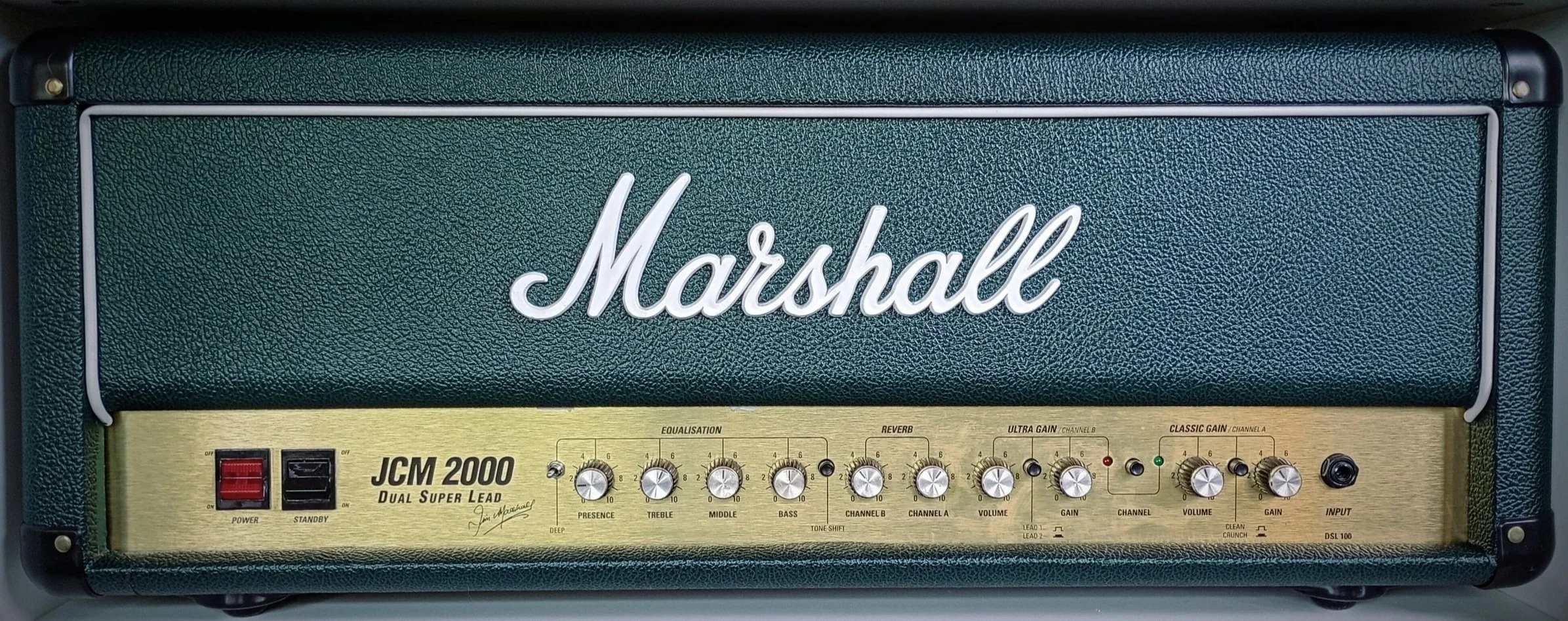
T&T Green & Gold - JCM2000
Please note this is a work in progress so it will improve over time. If this message has gone, then you’ll know it’s finished.
I commented on a Facebook group thread discussing the JCM2000 (was it good, what issues etc) & when asked what mods I had done/recommended, I realised that apart from a large collection of badly named LTSpice files, I hadn’t properly written down what changes I had made, why, and the results. So this is it…
Why mod the JCM2000?
The JCM2000 has/had a pretty terrible reputation. Not as vintage mojo infused as a plexi, as classic as the JCM800 or as hard core as the JCM900, the 2000 was a bit meh. Add the well known bias issues to the mix, and it doesn't make a pretty picture.
However, like the Fender HRD series, the JCM2000 was the main Marshall used for backlines. And like the HRD, I felt this was it's problem. It was a bit soulless, the designers had exchanged an identifiable character for versatility.
So, in my wisdom I thought I would have a crack at fixing this. Or at least copying the work of more qualified people.
Aim of the mods
Green channel 1 (Clean) - Keep mostly as is, remove some of the bass whilst still maintaining the full bluesy tones.
Green channel 2 (Crunch) - Move the tone closer to the JCM800
Red channel 1 (Lead 1) - Alter gain to be more of a step up from Green channel 1. Alter eq to be closer to plexi/channel 1.
Red channel 2 (Lead 2) - Remove mud, tighten bass. Make this channel more of a definite modern metal sound.
Misc
Install a Dr Tube stable bias kit** - the amp I was working on showed signs of bias failure, with one tube showing a scorched logo.
Add a filter choke - (I think, but I’ll double check) a Hammond 159R
Adjustable/switchable deep circuit
Adjustable/switchable mid circuit
What was done
The starting point for these mods was the Joey Mods page on the Marshall forum (link to follow), then Jason Tongs Headfirst mods (link), then the Fortin mods (link).
The brackets indicate where I took took the final value from though a lot of the same components are changed by each ‘modder’ just the values differ.
Main board #60 - Preamp
Original schematic (external link)
C12 - 4.7uf -> 1uF (T&T)
R14 - 1.8k -> 2.7k (T&T)
R15 - 1k -> 2.7k (Headfirst)
C13 - 1uF -> 680nF (Headfirst)
C17 - 470pF -> 680nF (T&T) - this seems suspicious, so be warned.
C16 - 4.7nF -> 2.2nF (Fortin)
C18 - 470pF -> 680pF (T&T)
R23 - Add 220pF in parallel (Fortin)
R31 - 1k -> 830R (SIR 36/Slash mod)
Main Board #60 - Power amp
R71 - 270R -> Hammond 159R Choke
Board #61 - Tone sculpting
Original schematic (external link)
Channel #1
C8 - 4.7nF -> 0.68nF
C7 - 470pF ->2.2nF
C6 - 2.2nF -> 2x 2.2nF in series
Channel #2
C10 - 4.7nF -> 2.2nF (Joey)
R20 - 47k -> 1nF (T&T)
R21 - 150k -> 220k (Headfirst)
C12 - 470pF -> 220pF (Headfirst)
C13 - 470pF -> 680pF
Resonance Circuit
R43 - 10k -> 10k Audio Pot or 3 way switch (switch looks cleaner)
EQ circuit
Mid Shift - The below doesn’t include how the connections are made as I need to check the amp. However the idea is there.
Swap push button for a 3 way switch with center - normal, up - mid boost, down - mid cut.
C20a No connection - Mid cut
C20b 470pF -> 220pF - Mid normal
C20c 1nF - Mid boost
Components
As ever, components were upgraded with:
Filter capacitors - Nichicon
Cathode bypass capacitors - Nichicon ‘Muse’ bi-polar electrolytics.
Preamp coupling capacitors
Mallory-CD/Knowles 150 film
Vishay MAL2021 electrolytics
Power amp coupling capacitors
CD/Knowles 715P Orange Drops
** Truth & Tone is not affiliated or connected to Dr Tube. T&T makes no income from linking to or recommending products from other vendors.
